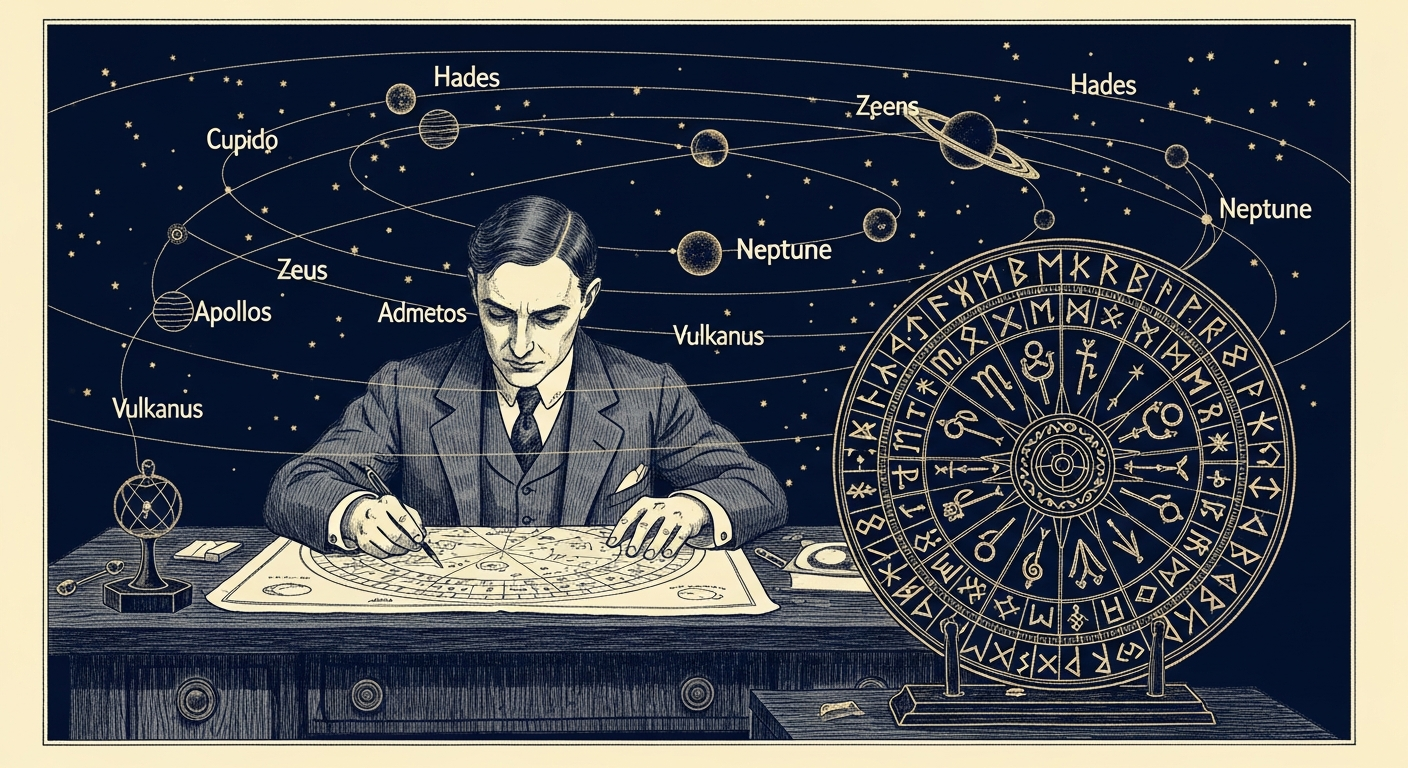
🌟 The Origin — Hamburg School
Uranian Astrology — known in German as Hamburger Schule (Hamburg School of Astrology) — originated in Hamburg, Germany, in the early 20th century, pioneered by Alfred Witte (1878–1941).
Witte was a surveyor and World War I veteran. While serving on the front lines, he attempted to apply traditional Western astrology to real-world events and found it insufficiently precise. This prompted him to develop a new, more mathematically rigorous system.
Around 1913, Witte began developing the 90-degree dial concept. In 1925, together with Friedrich Sieggrün (1877–1951), he published "Regelwerk für Planetenbilder" (Rules for Planetary Pictures), which became the foundational text of the system.
After Witte's death in 1941, Sieggrün continued developing the system. Uranian Astrology spread to the United States through Lilly Doorn and Hans Niggemann in the 1930s–1960s, and later expanded to Asia, including Thailand.
⚙️ Core Innovations — What Makes Uranian Unique
🔵 The 90-Degree Dial
Instead of a traditional 360-degree wheel, Witte folded the chart into four equal quadrants. Planets at 0°, 90°, 180°, and 270° to each other appear adjacent on the 90-degree dial. This makes it far easier to spot Cardinal aspects (0°/90°/180°/270°) and Semi-Square aspects (45°), enabling more precise aspect identification.
⚖️ Midpoints
A midpoint is the exact halfway position between two planets. If the Sun is at 10° and the Moon is at 20°, their midpoint is 15°. Uranian Astrology holds that this midpoint carries a unique energy that can be activated by a third planet, expanding analysis from "two-planet aspects" to "three-planet combinations" known as Planetary Pictures.
🖼️ Planetary Pictures
Planetary Pictures are planetary equations such as A + B = C or A = B/C. When three or more planets stand in a Midpoint relationship, they form a specific meaning that can be looked up in Witte's Rulebook. For example, Sun = Venus/Jupiter indicates success in love or finance.
🪐 The 8 Hypothetical Trans-Neptunian Planets
Witte observed that the known planets could not fully account for certain events, so he postulated 4 hypothetical planets; Sieggrün later added 4 more, totalling 8. Although not real planetary bodies, they have been shown to produce accurate predictions when used alongside real planets.
Cupido
Family, art, social groups, associations
Hades
Decay, the ancient, secrets, medical/antique professions
Zeus
Goals, fire, power, ambition, military
Kronos
Authority, government, leaders, expertise
Apollon
Expansion, science, trade, widespread success
Admetos
Standstill, depth, focus, endurance
Vulkanus
Enormous power, explosive force, greatness
Poseidon
Truth, transparency, spirit, wisdom
⚖️ How It Differs from Western Astrology
| Aspect | Uranian | Western |
|---|---|---|
| Chart Wheel | 90-degree dial (folded x4) | 360-degree wheel |
| Main Tool | Midpoints & Planetary Pictures | Aspects (trine, square, etc.) |
| Planets | 10 real + 8 hypothetical = 18 | 10 planets (some add Chiron/Ceres) |
| Houses | Not used or minimally used | 12 houses are central |
| Precision | Mathematical/symmetrical focus | Symbolic/interpretive focus |
| Learning | Requires additional theory | More standardized teaching |
📚 Uranian Astrology Curriculum
Uranian Astrology learning is divided into several levels. A foundation in Western Astrology is generally recommended beforehand.
Foundation
- ✦10 planets and their meanings
- ✦12 zodiac signs and their qualities
- ✦Basic aspects (Conjunction, Opposition, Trine, Square)
- ✦Basic Western chart reading
Intermediate — Uranian Basics
- ✦The 90-degree dial and its use
- ✦Understanding Midpoints
- ✦8 hypothetical TNPs — meanings and application
- ✦Study Rules for Planetary Pictures
Advanced — Planetary Pictures
- ✦Planetary Pictures and planetary equations
- ✦Solar Arc Directions
- ✦Annual Ingress
- ✦Event Charts and predictive work
Expert Level
- ✦Combining Uranian + Traditional techniques
- ✦Reading Natal + Progressed + Transit together
- ✦Advanced Symmetrical Astrology techniques
- ✦Practice with real case studies
🌏 Uranian Astrology in Thailand & Asia
Uranian Astrology became known in Thailand during the late 20th century as Thai astrologers brought knowledge from the United States and Europe. Today, Uranian societies and study groups continue to develop and teach this discipline in Thailand.
UraTarot blends Uranian Astrology with Tarot through AI technology, making Uranian chart reading more accessible. The system calculates real planetary positions — including all 8 hypothetical Trans-Neptunian planets — and interprets them via UraTarot AI.