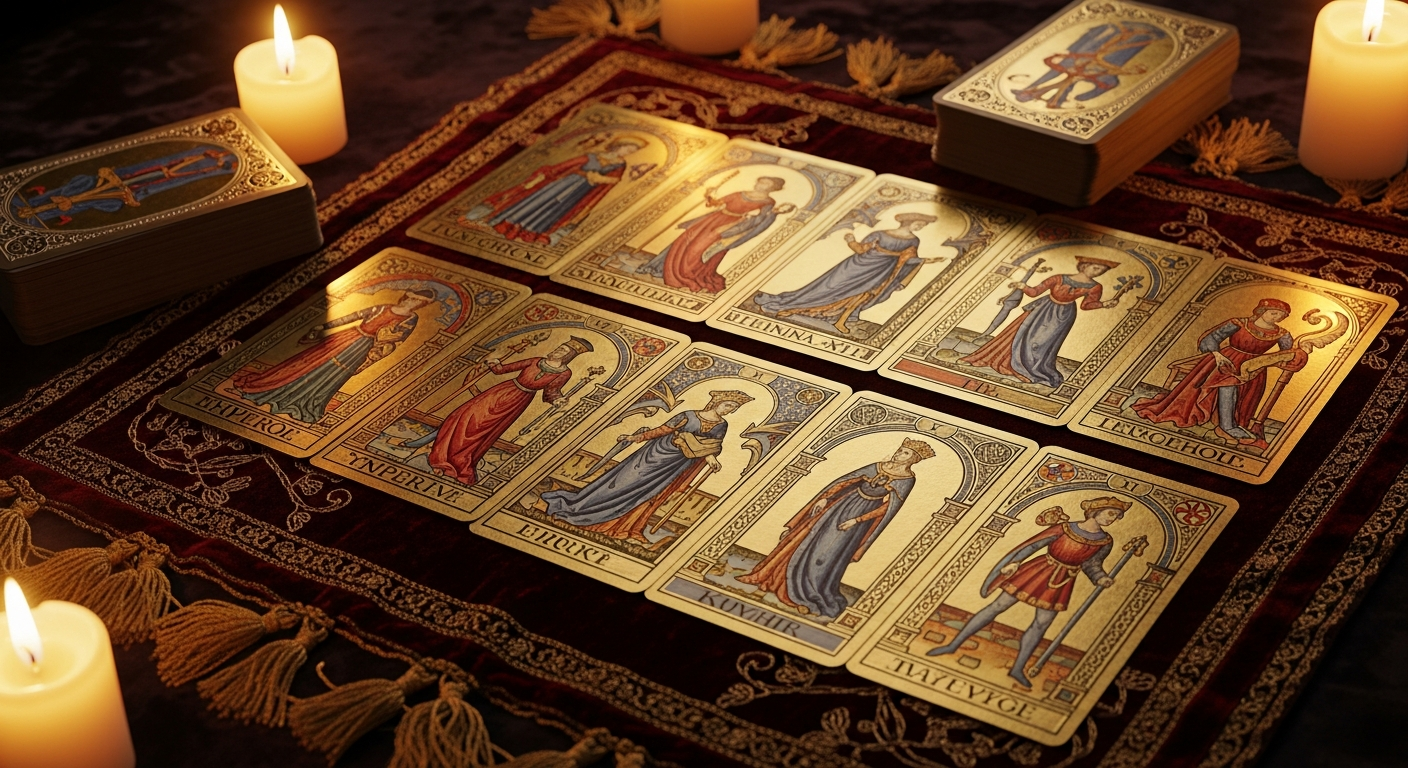
🎴 The Origin — Triumph Cards in the Italian Courts
Tarot cards originated in northern Italy around 1430–1440, during the reign of the Visconti-Sforza dynasty of Milan. Originally called "carte da trionfi" (triumph cards), they were simply playing cards for court games — not tools of divination.
The oldest surviving deck is the Visconti-Sforza Tarot, circa 1440–1450, painted by court artists with elaborately gilded figures. Surviving cards are now held in museums across the world.
The word "Tarot" comes from French, adapted from Italian "Tarocchi" — the name of a card game popular in northern Italy, central Europe, and Switzerland in the 15th–16th centuries.
📅 A 600-Year Timeline
1430–1450
Visconti-Sforza Tarot
Earliest known deck, painted for the Milan court. Has Major Arcana but not yet the full 78-card structure.
1500s
Tarot de Marseille
Colourful French-style standardised deck; became the template for modern European tarot.
1781
Antoine Court de Gébelin
French scholar claimed tarot originated from ancient Egypt (false), but linked tarot to esotericism.
1791
Etteilla — First Divination Deck
Jean-Baptiste Alliette (Etteilla) designed the first deck specifically for divination, establishing systematic card meanings.
1909
Rider-Waite-Smith Tarot
Arthur Edward Waite & Pamela Colman Smith created the first deck with full illustrated scenes on all 78 cards — became the world standard.
1944
Thoth Tarot
Aleister Crowley and Lady Frieda Harris created this Kabbalistic/Thelemic deck, another landmark in tarot history.
1960–Present
The Golden Age of Tarot
Tarot spreads worldwide with thousands of new decks; used in psychotherapy, self-development, and modern art.
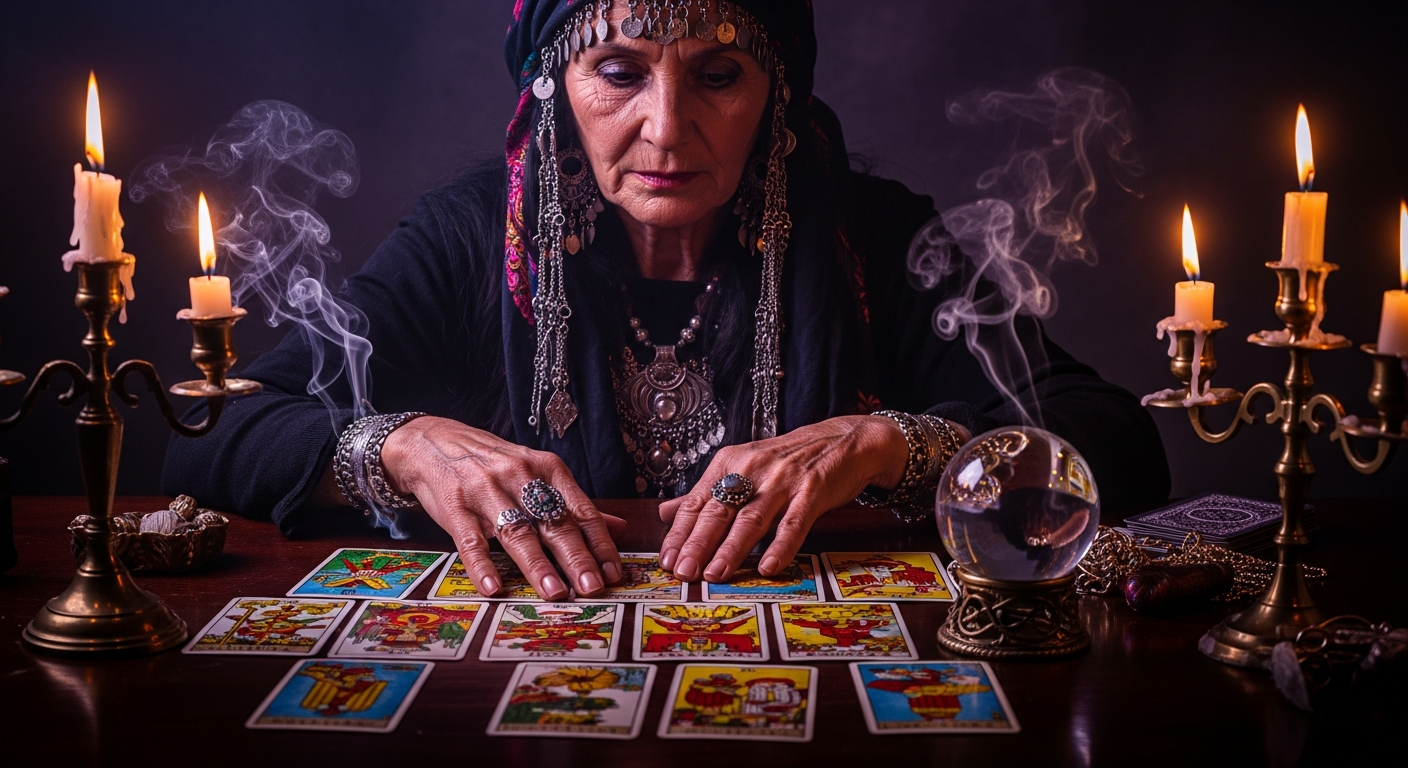
🃏 Tarot Structure — The 78 Cards
Major Arcana — 22 Cards
The 22 "trump" cards representing universal forces, cosmic archetypes, and life's major cycles — from card 0 (The Fool) to 21 (The World). Each card symbolises a major life force or event.
Minor Arcana — 56 Cards
4 suits of 14 cards each (Ace through 10 + 4 court cards: Page/Knight/Queen/King). Each suit represents a different element and life domain.
🌟 Famous Tarot Decks
Visconti-Sforza (1440–1450)
OriginThe earliest known deck, hand-painted with real gold for the Milan court.
Tarot de Marseille (1500s–1700s)
ClassicEuropean standard; bright colours; still widely used today, especially in France.
Rider-Waite-Smith (1909)
PopularThe modern world standard; full illustrated scenes on all 78 cards; ideal for beginners.
Thoth Tarot (1944)
EsotericBy Aleister Crowley; sacred geometry art; deep Kabbalistic symbolism.
Osho Zen Tarot (1994)
ModernA modern reinterpretation through Zen and Osho philosophy, focused on self-awareness.
🤔 "Gypsy Cards" vs Tarot — Common Confusion Explained
In Thailand, "ไพ่ยิปซี" (Gypsy cards) is commonly used to mean tarot — but they are technically different:
🃏 Tarot Cards
- • 78 cards
- • Major Arcana + Minor Arcana
- • Origin: Italy, 1430s
- • Complex symbolic system
🔮 Gypsy / Lenormand Cards
- • 36–52 cards
- • Simpler imagery (house, heart, bird…)
- • Developed in 19th-century France
- • More event-focused, easier to read
* Romani people (Roma) did not create or bring tarot to Europe — that is a historical myth.
🤖 Tarot in the Age of AI
Today, tarot is increasingly blended with Artificial Intelligence. AI can learn the meaning of all 78 cards, spread patterns, and user question context — then synthesise a coherent, nuanced interpretation.
UraTarot uses AI to interpret tarot cards, supporting multiple spread types — single card, 3-card, and 10-card Celtic Cross — combined with Uranian Astrology for deeper chart analysis. All readings are interpreted by UraTarot AI.